Jean Piaget’s Stages of Cognitive Development
The Swiss psychologist Jean Piaget (1896-1980) was a seminal figure of the 20th century, whose extensive studies on child cognitive development drastically changed our understanding of education, child-rearing, and meaning-making.
Piaget’s research delineated how children build cognitive maps across different layers of their subjective reality. By evaluating the number of mental reference points a child could maintain and mediate between simultaneously, Piaget demonstrated the ongoing formation of new cognitive structures and their evolution—the mechanism behind a maturing intellect.
According to Piaget, the primary role of intellect is to make sense of our existence by uniting present experiences with previously formed ideas, our memories, to create a coherent understanding of life. Through this process, our mind constructs a new vision of the future, reflecting our self-image, influenced by our interpretation of the external world in the present.
Piaget coined this theory ”Constructivism”, implying that cognition itself is a living, changing construct rather than a static entity. This construct consistently morphs in response to life’s myriad of experiences, events, and challenges, suggesting that the information humans gather soley through sensory inputs will never provide an entire picture of reality.
Instead, knowledge is in a state of ceaseless evolution, continuously crafted through the Self’s interaction with the external world on a moment-to-moment basis. Another significant contribution from Piaget was his assertion that the cognitive maps a child creates of their reality are largely predictable and measurable, meaning that the shifting perspectives of children are not arbitrary but follow discernible patterns.
Empirical evidence indicates a foreseeable progression and a geometric sequence of alternations between self-perception, empathy, semantic representations, and physiological sensations. Piaget meticulously depicted these developmental milestones through a four-stage model, the key points of which are briefly summarized as follows:
1. The Sensorimotor Stage
2. The Preoperational Stage
3. The Concrete Operational Stage
4. The Formal Operational Stage
 1. The Sensorimotor Stage
During this phase, a child perceives the world solely through the lens of physical experiences derived from their five senses: sight, touch, smell, taste, and hearing. These sensory experiences harmonize with the child’s physical movements to shape their understanding of the world.
Interactions with reality are direct and unfiltered, unhindered by linguistic representations or interpretive frameworks. There is full congruence between the child’s mental state and its bodily movements. At this stage, the child lacks the capacity to consider the world from another’s perspective, indicative of their egocentric disposition.
Even their perception of their body positions is at the universe’s center. Following an extensive exploration phase of innate reflex systems, such as reaching, sucking, and grasping, the child gradually begins to cultivate rudimentary conscious routines. Consequently, they begin to replicate actions that were initially performed unintentionally.
Coinciding with this development, the child starts to comprehend the concept of object permanence; the understanding that objects continue to exist even when not in direct view. This cognitive leap facilitates the emergence of intentional actions: a capacity that yields a profound sense of fulfillment and fuels the child’s curiosity for further exploration.
As this stage culminates, the child acquires the ability to juxtapose diverse objects with different properties purely to observe the ensuing outcomes. This marks the onset of a rudimentary scientific instinct for exploring the world’s numerous possibilities.
2. The Preoperational Stage
The child now begins to use symbols, such as words and markings on paper, instead of solely relying on the body’s impressions and movements. In this phase, language mediates between sensory experiences and various physical impulses.
As a result, the child develops the capacity to represent actions and objects that are not physically present. This cognitive symbolic function enables a person to remember and visualize images of objects in their mind without needing the object in front of them.
However, this development is not yet sufficient for using scientific logic or cognitively manipulating information. These cognitive discrepancies between the adult’s world and the child’s become evident through the child’s engagement in imaginative play.
The child might pretend to feed a sibling, represented by a doll, or treat a toy as if it were alive. Sticks transform into swords, dishes into spaceships, and cones into dogs. At this preoperational stage, reality is often experienced akin to a fairy tale. A notable characteristic of this stage is the child’s limited cognitive flexibility to empathize with others’ perspectives.
Nonetheless, the child begins to understand that different people perceive the world in various ways. This newfound understanding prompts the child to start asking ”why,” using this question as a tool to contrast their inner world with the external one.
As this stage approaches its conclusion, the child begins to comprehend that they possess a vast reservoir of knowledge, albeit uncertain of its origin. The urge to create a more coherent system for classifying objects motivates the child to start exercising cognitive functions attributed to the subsequent stage. The child begins to understand the concept of selfhood, realizing ”I own things that define me, therefore there is an I.”
3. The Concrete Operational Stage
In this phase, the child’s logic becomes more grounded in reality, somewhat akin to adult thinking. However, a key distinction lies in the fact that abstract and hypothetical reasoning have not yet fully matured, preventing the child from employing principle-based methods. As a result, the child can only solve problems related to tangible events and objects. Several cognitive tools become accessible and crucial for the child at this stage: classification, conservation, categorization, and reversibility.
Classification involves organizing disparate items into hierarchically arranged subgroups and named classes, thereby facilitating the discernment of their specific differences and similarities. Conservation is the understanding that an object can retain its quantity even if its appearance changes; alterations in the object’s distribution do not necessarily affect its count, mass, volume, or length.
Categorization is a problem-solving strategy that involves reordering mental categories, such as recognizing that “My pet is a Labrador, a Labrador is a dog, a dog is an animal, so a Labrador is an animal — but not all animals are Labradors.” Reversibility entails understanding that some entities, once transformed, can revert to their original state.
For example, water can be frozen into ice and then thawed back into a liquid state, whereas a cracked egg cannot revert to being uncracked. By utilizing these tools and others, the child constructs cognitive maps centered on physical objects and spaces, subsequently testing their validity against reality.
For instance, it becomes possible to systematically recreate a memory map to recall where an item was left, eliminating the need to physically search every room. A general limitation of this form of thinking is its reliance on inductive generalizations rather than deductive reasoning. In a later stage, the focus shifts from analyzing the connections between physical objects to examining ideas themselves.
4. The Formal Operational Stage
While the previous stage emphasized the manipulation and organization of physical objects, the formal operational stage involves handling abstract concepts and ideas. In this stage, the child transitions into hypothetical reasoning, which encompasses the ability to anticipate the potential implications of specific events, causes, or effects to a certain extent. It is through this refinement in cognitive processes that the child progresses into a functioning adult.
The capacity to conduct experiments, engage in metacognition (thinking about thinking), formulate hypotheses, perceive the world from someone else’s perspective (empathy), and solve moral issues, becomes feasible. Constructing hypothesis (establishing ”if-then-else” scenarios) and subsequently verifying their validity through observations and experiments become the child’s primary focus. Ideas and principles can now be conceptualized as tangible entities and manipulated into integral components of a dynamic referential framework.
For instance, a child might think, “If I look ahead a year and envision achieving my goal, then count the steps backwards to analyze the path that led me there, what steps did I have to apply? And how could I prioritize these steps into my immediate future?” Enhanced pattern recognition enables the child to predict future outcomes to some extent based on present interactions and events. It’s the ability to introspectively evaluate our thoughts that grants us this cognitive advantage.
The number of cause-and-effect relationships that can be viewed from this vantage point theoretically knows no limits. Here, monumentally the child overcomes their egocentric perspective and tendencies; learning to apply their ingenuity in conducting formal operations; crafting and utilizing external tools as augmentations of their inherent cognitive capabilities. Thus, we can derive from this that we learn more when we are compelled to invent.
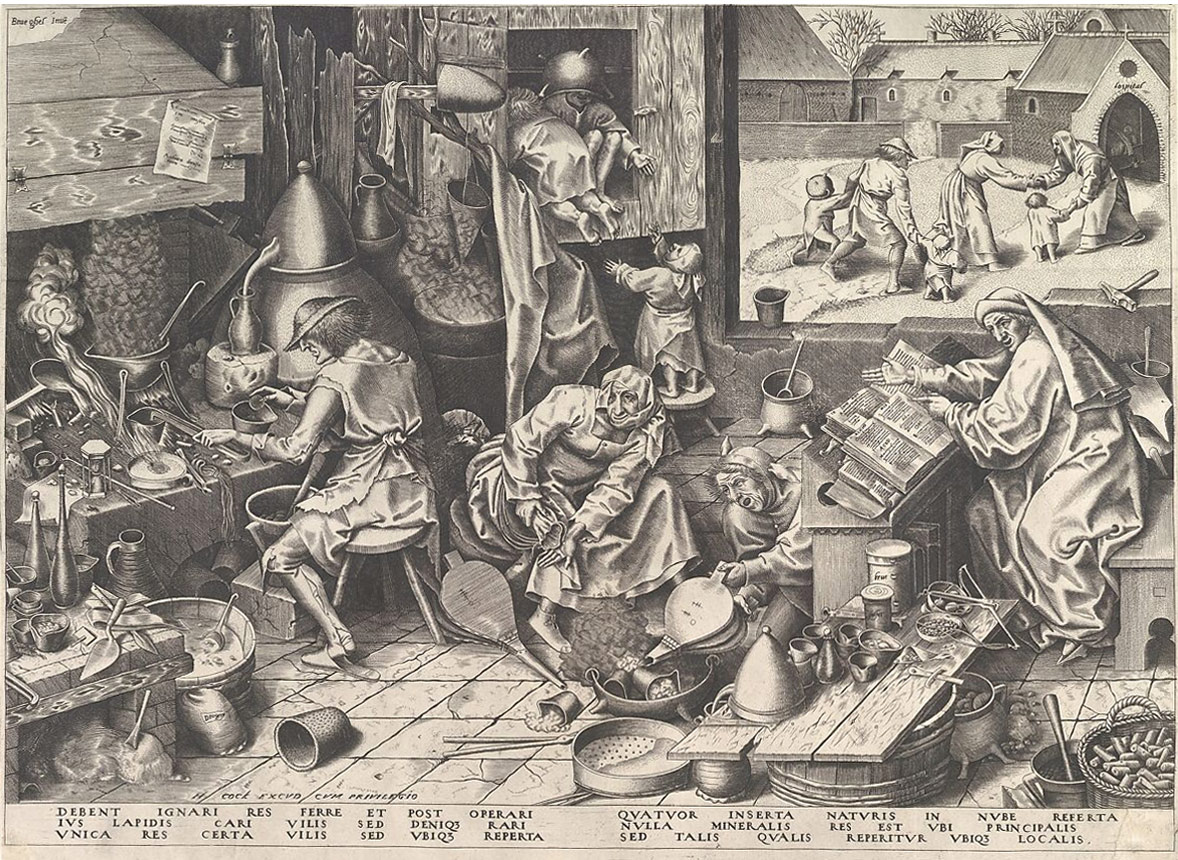
In the spirit of discovery, The Alchemist


